
Guide
Sleep and Autism: Understanding the Whole Picture
Understand how autism can interact with sleep through sensory differences, communication, routines, circadian rhythms, sleep associations, anxiety, and medical factors.
Sleep and Autism: Understanding the Whole Picture
Sleep can be challenging for many autistic children, but there is no single autistic sleep pattern.
Some children have difficulty falling asleep, others wake frequently, wake very early, or have difficulty maintaining a consistent sleep schedule.
Research reviews have found that sleep problems are common in autistic children and can include insomnia, circadian rhythm difficulties, parasomnias, and sleep-disordered breathing.
Autism Does Not Mean a Child Cannot Sleep Well
An autism diagnosis does not determine how a child will sleep.
Some autistic children sleep very well, while others need more individualized support.
Autism can affect communication, sensory processing, flexibility, routines, and responses to environmental changes, and these differences may interact with sleep.
It is important to understand the individual child rather than assuming that every sleep difficulty is caused by autism itself.
Why Sleep Can Be Different for Autistic Children
Sleep difficulties in autism can have multiple contributing factors.
Research describes biological, behavioral, psychological, sensory, and environmental influences.
Difficulty adjusting to changes in routine, heightened sensitivity to sounds or textures, differences in arousal regulation, anxiety around bedtime, and challenges communicating discomfort can all be relevant for some children.
These factors vary considerably from one child to another.
Sensory Differences Can Matter at Bedtime
For some autistic children, the sensory environment that another child barely notices can be extremely important.
A tag in pajamas, a particular fabric, room temperature, a humming appliance, a hallway light, or the sound of a sibling moving around may make settling more difficult.
Other children may actively seek certain sensations, such as pressure, movement, or familiar sounds.
The goal is not to assume a particular sensory strategy will work for every child, but to observe what the child is communicating.
Routine and Predictability Can Be Powerful
Many children benefit from predictable bedtime routines, and predictability can be particularly helpful for autistic children who find unexpected changes difficult.
A consistent sequence can reduce uncertainty around bedtime.
The routine might include the same general order of bath, pajamas, feeding or snack, books, and lights out.
Predictability does not mean every night has to be identical.
The goal is enough consistency to make bedtime understandable while gradually building flexibility.
Communication Matters
Not every child communicates tiredness, discomfort, or nighttime needs in the same way.
A child may not say, "I am overtired," "the room is too loud," or "I am worried about going to sleep."
Instead, the message may appear as increased movement, repetitive behavior, scripting, leaving the bedroom, crying, or becoming unusually active.
Understanding a child's communication style can make sleep support much more effective.
Bedtime Resistance Is Not Always a Behavior Problem
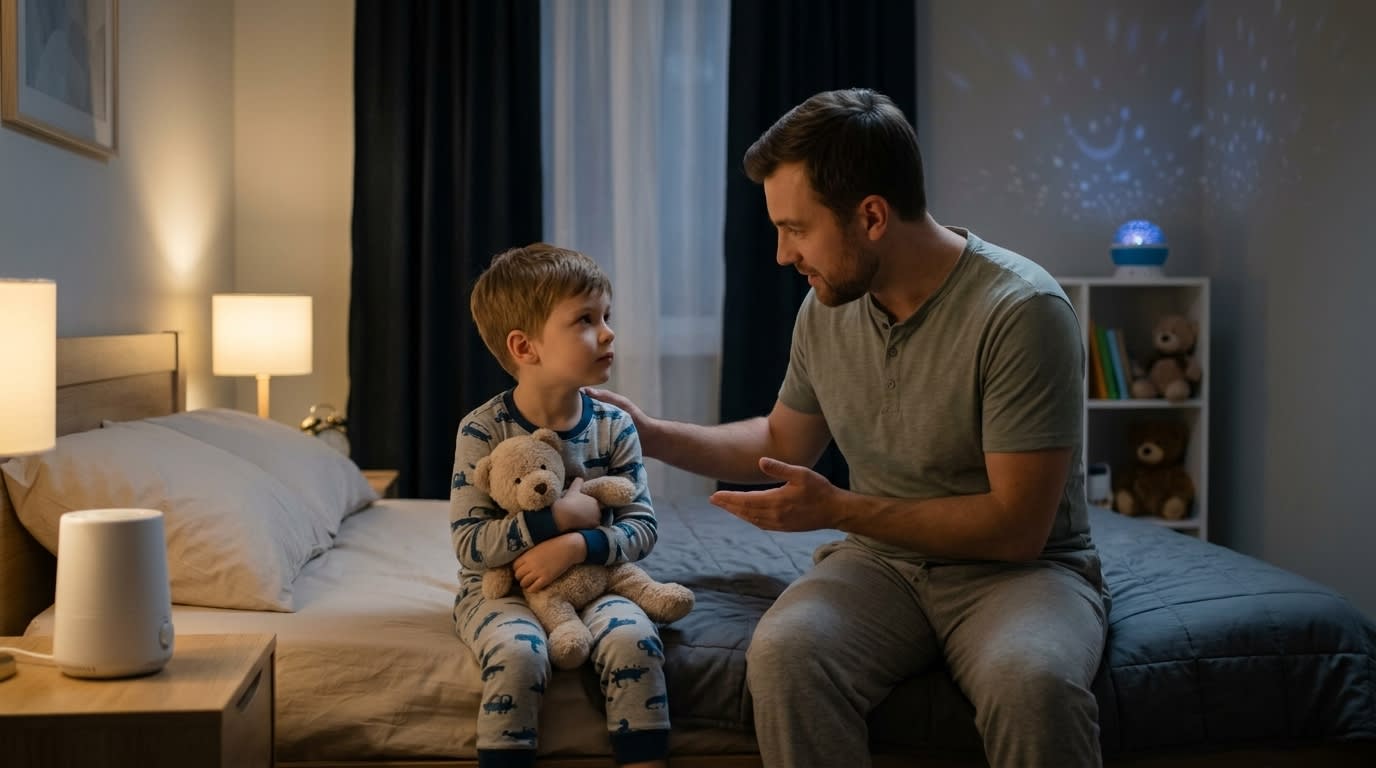
Autistic children may have difficulty with transitions, and bedtime is a major transition from an active part of the day to a quieter and less predictable period.
If a child becomes distressed at bedtime, it is worth asking what the transition feels like from the child's perspective.
Instead of immediately increasing consequences or pressure, consider whether the child needs more preparation, visual information, sensory support, or a slower transition.
Sleep Associations and Autism
Autistic children can develop strong sleep associations just like other children.
A particular parent, movement, sound, object, location, or routine may become an important cue for falling asleep.
This is not inherently a problem.
If the association works for the family, it may not need to be changed.
If the child is waking repeatedly because the same conditions have to be recreated throughout the night, the family may want to gradually expand the child's sleep skills.
A Responsive Approach to Sleep Coaching
Sleep coaching for an autistic child should be individualized.
The same strategy that works beautifully for one child may be overwhelming or ineffective for another.
A responsive approach considers temperament, communication, sensory needs, developmental level, medical factors, family circumstances, and the child's ability to understand the changes being introduced.
Some children do well with a gradual camping-out approach in which a parent stays nearby and slowly reduces support.
Others may benefit from practicing one small change at a time.
Connection and Boundaries Can Coexist
Supporting an autistic child's sleep does not require choosing between responsiveness and boundaries.
A parent can say, "It is bedtime. I am here with you," while maintaining a predictable limit around leaving the bedroom.
A child can receive comfort without the bedtime routine changing completely every time they protest.
Warmth and consistency can coexist.
Look Beyond Sleep Habits
Before treating a persistent sleep difficulty as a behavioral issue, consider whether there may be another contributor.
Sleep-disordered breathing, restless legs syndrome, gastrointestinal discomfort, anxiety, medication effects, and other medical or developmental factors can affect sleep.
Research on sleep in autism emphasizes evaluating co-occurring medical contributors rather than assuming every difficulty is simply behavioral.
Circadian Rhythm and Early Morning Waking
Some autistic children experience difficulties with the timing of sleep as well as sleep quality.
A child may have a delayed sleep schedule, struggle to fall asleep at a conventional bedtime, or wake very early.
A consistent wake time, appropriate daytime light exposure, a predictable evening routine, and careful attention to naps can all be part of a sleep plan.
Persistent circadian concerns should be discussed with a pediatrician or pediatric sleep specialist.
Sleep and the Family
When an autistic child sleeps poorly, the effects often extend beyond the child.
Parents and caregivers can become chronically sleep deprived, and the household may begin organizing around nighttime waking.
This does not mean parents are doing something wrong.
It means sleep is a family issue as well as a child issue.
Supporting the caregiver is part of good sleep care.
When to Seek Professional Help
Professional evaluation is appropriate when sleep problems are persistent, significantly affecting daytime functioning, or causing substantial family stress.
It is especially important to seek medical guidance when there are possible breathing problems, significant daytime sleepiness, unusual movements during sleep, persistent pain, poor growth, or other concerning symptoms.
Behavioral sleep interventions with caregiver involvement are commonly used for pediatric sleep problems, including in autistic children, but the intervention should be individualized and paired with evaluation for medical contributors.
The Bottom Line
Autistic children can absolutely develop healthy, restorative sleep.
Sleep may simply require a more individualized approach.
Sensory differences, communication style, transitions, routines, anxiety, circadian timing, and medical contributors can all be relevant, and not every child will need the same strategy.
The goal is not to make an autistic child behave like a neurotypical sleeper.
It is to understand the child in front of you, identify what is interfering with sleep, and build supportive routines and sleep skills that respect the child's nervous system and the family's needs.
A Tiny Sleep Studio Approach to Autism and Sleep
At Tiny Sleep Studio, I believe autistic children deserve sleep support that starts with understanding rather than judgment.
A sleep challenge is not a character flaw, and bedtime resistance is not automatically defiance.
Before changing a sleep behavior, I want to understand communication, sensory needs, routine, feeding, medical factors, and the child's individual way of experiencing the world.
Sleep coaching can be responsive, structured, and individualized at the same time.
The goal is to help the child get the restorative sleep they need while preserving connection, respecting neurodiversity, and giving parents practical strategies they can actually use.